

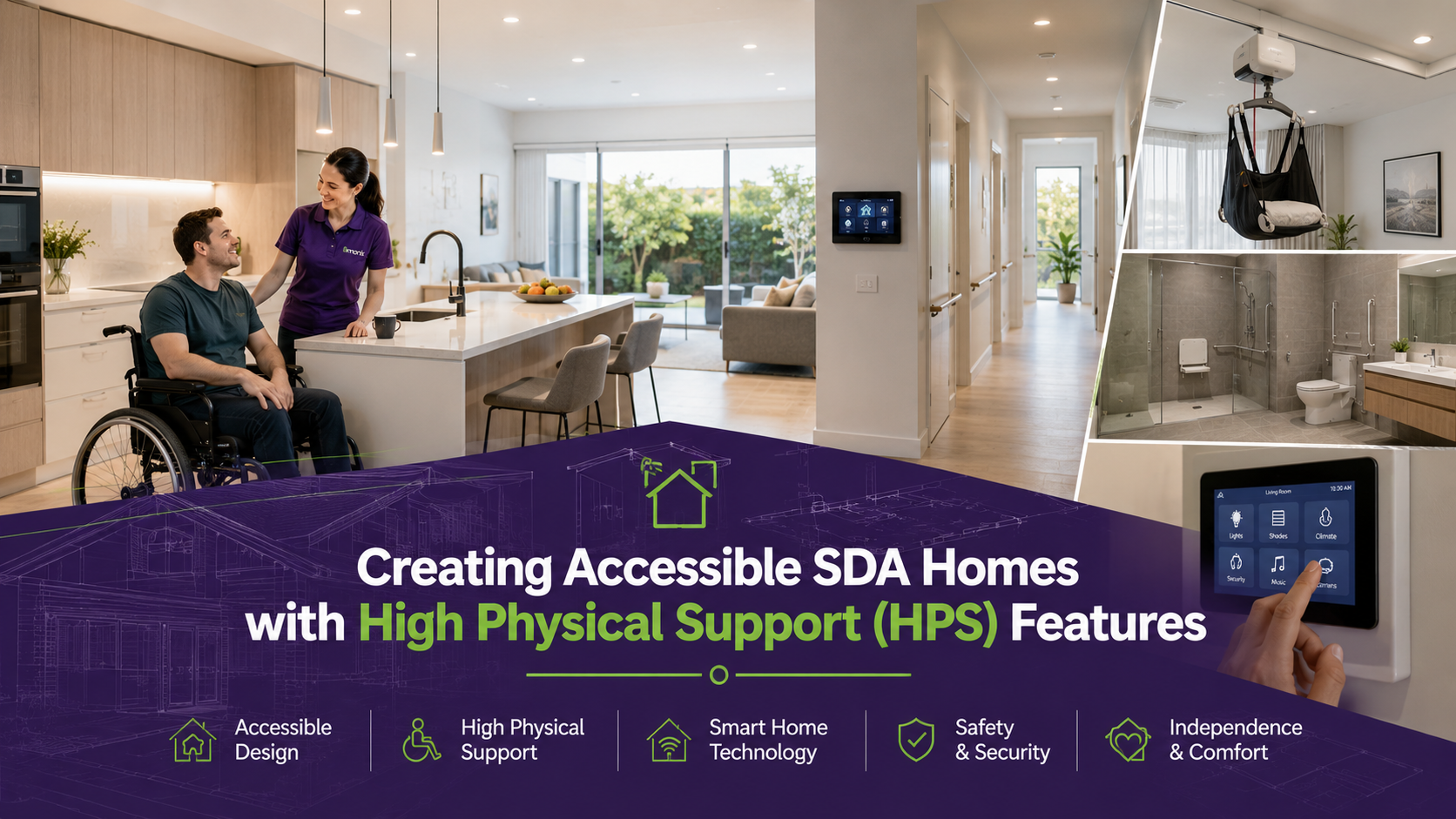
Specialist Disability Accommodation (SDA) with High Physical Support (HPS) features is purpose-built housing designed for NDIS participants with significant functional impairment. These homes include ceiling hoists, reinforced wet areas, wider doorways, and backup power systems to support safe, dignified, and independent living.
For many Australians living with significant physical disability, finding a home that genuinely meets their needs has historically been one of the most frustrating parts of navigating the NDIS. Standard rental properties rarely accommodate wheelchairs, hoists, or complex care equipment. And while modifications to existing homes are possible, they often fall short of what people with higher support needs actually require day to day.
That is where Specialist Disability Accommodation with High Physical Support features comes in. It is not simply housing with a few grab rails added. HPS-category SDA represents a distinct building standard under the NDIS framework, designed specifically for participants whose disability creates very high demands on their living environment.
This article explains what HPS SDA housing is, what physical features these homes must include, who qualifies for this type of accommodation, and how to navigate the process of finding and accessing it. If you or someone you support has significant physical support needs, understanding this category of housing could make a meaningful difference to long-term quality of life.
What Is Specialist Disability Accommodation (SDA) Under the NDIS?
Specialist Disability Accommodation is a funding category within the NDIS designed to cover the cost of purpose-built or significantly modified housing for participants with extreme functional impairment or very high support needs. SDA funding pays for the physical home itself, not the personal support delivered within it. Support services like personal care or daily assistance are funded separately, typically through Supported Independent Living or other NDIS line items.
The NDIS recognises several SDA design categories, each reflecting a different level of accessibility and support infrastructure. These categories are Improved Liveability, Fully Accessible, Robust, and High Physical Support. High Physical Support is the most complex and highest-funded of these categories, reflecting the significant construction requirements and specialised features these properties must include.
SDA is not available to all NDIS participants. It is targeted at those for whom standard or even moderately modified housing would be genuinely insufficient to meet their needs. According to the NDIS, SDA is intended for around six percent of participants, those with the most significant support needs.
What Does High Physical Support (HPS) Mean in Practice?
High Physical Support SDA is designed for participants who require substantial physical assistance throughout the day and who may rely on powered mobility equipment, mechanical lifts, or in-home clinical care. The HPS design standard is set out in the NDIS SDA Design Standard, which all registered SDA providers and developers must meet.
To achieve HPS certification, a property must meet a defined set of structural and functional requirements. These go well beyond standard accessibility features and reflect the real-world demands of living with significant physical disability.
What structural features are required in HPS SDA homes?
A certified HPS SDA property must include:
- Ceiling hoists or track systems installed throughout the home, or structural provision for hoist installation, to support transfers and mobility
- Reinforced walls and ceilings capable of bearing the load of overhead lifting equipment
- Extra-wide doorways and corridors to accommodate powered wheelchairs and larger mobility aids
- Wheelchair-accessible wet areas with roll-in shower facilities and adjustable fittings
- Height-adjustable benchtops and fixtures in kitchens and bathrooms to support use from a seated position
- Emergency power backup to ensure continuity for participants reliant on powered equipment such as ventilators or powered chairs
- Assistive technology integration, including smart home features, intercoms, and electronic door controls
- Step-free access throughout, including from the street and outdoor areas
These features collectively reflect what it means to live in an HPS property. They are not optional extras. They are the baseline that distinguishes genuine High Physical Support housing from a standard accessible home.
Who Is Eligible for High Physical Support SDA Funding?
Eligibility for SDA funding, and specifically for the HPS design category, is determined through the NDIS planning process. A participant must demonstrate that their support needs cannot be reasonably met through home modifications or mainstream housing, and that purpose-built SDA housing would deliver better outcomes in terms of independence, safety, and reduced reliance on paid support.
Participants who are typically considered for HPS SDA include those with:
- Spinal cord injuries requiring powered wheelchairs and mechanical lifts
- Acquired brain injuries with high ongoing physical support needs
- Progressive neurological conditions such as motor neurone disease
- Complex physical disabilities requiring clinical-level care in the home environment
Having a diagnosis alone is not sufficient. The NDIS assesses functional capacity and the relationship between housing design and support outcomes. A thorough functional assessment and housing needs assessment are usually required to build a case for HPS SDA inclusion in a participant’s plan.
It is worth noting that SDA funding is separate from the support services delivered in the home. Many participants living in HPS SDA properties also access Supported Independent Living in Adelaide, which funds the day-to-day support workers who assist with personal care, meals, and daily living tasks.
How HPS SDA Supports Independent Living
The purpose of HPS SDA housing is not simply to provide a safe place to live. It is to enable genuine independence and dignity for people whose disability would otherwise make everyday life far more dependent on others.
Ceiling hoists, for example, transform the experience of getting out of bed, moving to a bathroom, or transitioning between spaces. Without them, each transfer requires significant manual assistance from one or more support workers, which carries risk for both the participant and the worker. A well-designed HPS home reduces that physical burden substantially.
Smart home technology integration takes this further. Voice-activated controls, automated doors, and remote lighting management allow participants to exercise far greater control over their environment without needing to call for assistance for tasks that most people do automatically. This kind of autonomy matters. It has a direct impact on wellbeing, confidence, and the ability to maintain a sense of agency over one’s own home.
For participants who rely on ventilators, feeding pumps, or powered mobility equipment, the emergency power backup requirement is not a convenience feature. It is a clinical necessity. HPS properties address this at a structural level, building resilience into the home itself.
The Connection Between SDA and SIL: What Participants Need to Know
A common point of confusion for participants and families navigating the NDIS is the relationship between SDA and SIL. These are two separate funding streams that often work together, but they cover different things.
SDA funding covers the cost of the physical property, that is, the home itself and its specialised features. SIL funding covers the support workers who assist the participant within that home. For someone living in an HPS SDA property, both are typically required.
It is also possible for some participants to live in SDA housing without SIL, particularly those who have informal support from family or who self-direct their in-home care. Conversely, SIL can be delivered in non-SDA properties for participants who do not meet the SDA eligibility criteria.
If you are trying to understand which combination of supports is right for your situation, speaking with a registered NDIS provider who has experience across both accommodation and support services is a practical starting point. Monix Disability Service offers both SDA accommodation in Adelaide and Supported Independent Living, which means participants can access joined-up support without needing to coordinate between multiple unrelated organisations.
Accessing SDA in Adelaide: What the Process Looks Like
For participants in South Australia, accessing HPS SDA funding requires a clear process. Here is a general overview of the steps involved.
Step 1: Confirm NDIS eligibility and existing plan details. If a participant does not yet have an NDIS plan, the first step is accessing the scheme itself. Those already on the NDIS need to request an SDA assessment as part of their next plan review or through a plan change request.
Step 2: Obtain a functional assessment. An occupational therapist with experience in SDA assessments can provide the evidence needed to support an HPS housing application. This assessment documents how the participant’s disability affects their housing needs and why standard accommodation would be unsuitable.
Step 3: Develop a housing needs assessment. This document sets out the specific features required in the participant’s home environment, which informs the SDA design category that is recommended.
Step 4: Work with a registered SDA provider. Once SDA funding is approved, participants can search for available HPS properties through the NDIS SDA register or with the assistance of a local provider. In Adelaide, Monix Disability Service supports participants through this process, helping them understand their options and connect with appropriate housing.
Step 5: Coordinate SIL and other support services. Moving into an SDA property is the beginning, not the end. Coordinating the right support workers and services ensures the living arrangement functions as intended.
Why the Right Provider Makes a Difference
Not all registered NDIS providers have the same depth of experience with high physical support accommodation. Choosing a provider who understands both the built environment requirements and the lived experience of participants with complex needs matters.
Monix Disability Service works with NDIS participants across Adelaide who have diverse and high-intensity support needs. As registered NDIS providers in Adelaide, the team offers support across accommodation, daily living assistance, community participation, and complex care. This means that participants and families are not managing multiple disconnected providers across different parts of their plan.
The team at Monix Disability Service also brings practical knowledge of the local Adelaide housing landscape, which can be genuinely helpful when navigating the SDA market and identifying properties that genuinely meet HPS standards.
Taking the Next Step Toward HPS SDA Housing
Finding the right home takes time, especially when the stakes are this high. The most important thing is to start the conversation early, gather the right evidence through functional assessments, and work with providers who understand the HPS design standard and what it means in practice.
If you or someone you support may be eligible for High Physical Support SDA and you are based in Adelaide or South Australia, reaching out to an experienced local provider is a sensible first step. Monix Disability Service is available to discuss your situation and help you understand the pathway forward.
Contact Monix Disability Service at 0411 666 649 or visit the NDIS services page to learn more about accommodation and support options in Adelaide.
Frequently Asked Questions About HPS SDA Housing
What is the difference between High Physical Support SDA and Fully Accessible SDA?
Fully Accessible SDA is designed for participants with significant physical disability who can mobilise independently using a wheelchair. High Physical Support SDA goes further, incorporating ceiling hoists, emergency power backup, and assistive technology integration for participants who require mechanical support for transfers and who may depend on powered clinical equipment.
Can I choose where my HPS SDA property is located?
Participants have the right to express housing preferences, including location. However, availability of HPS-certified properties varies by area. In Adelaide, the number of registered HPS SDA dwellings is growing, but availability at any given time depends on the local market. Working with a registered provider can help identify suitable properties more efficiently.
Does HPS SDA funding cover renovations to an existing home?
SDA funding is generally intended for purpose-built or substantially modified dwellings that meet the certified design standard. Home modifications to existing properties are typically funded through a different NDIS support category. An NDIS planner or support coordinator can clarify which funding pathway applies to a specific situation.
How long does it take to get SDA funding approved?
Timelines vary depending on the complexity of the participant’s plan, the quality of the supporting evidence submitted, and NDIS processing times. Gathering thorough assessments and working with an experienced support coordinator can help reduce delays. In some cases, participants may access short-term or medium-term accommodation while their long-term SDA application is being processed.
Can I access both SDA and SIL funding at the same time?
Yes. SDA and SIL are separate funding streams that address different needs. SDA covers the physical property; SIL covers the support workers within it. Many participants with high physical support needs access both simultaneously. An NDIS planner can build both into a participant’s plan where the evidence supports it.